Excuse me just allow me to side track a little :
The picture below where the PAP
buildings are looks very much or exactly like the Kwong Wai Shiu
Hospital which was asked to leave the location. Kwong Wai
Shiu was located along Serangoon Road near Boon Keng
MRT.
If the motive of asking Kwong Wai
Shiu Hospital which provides cheaper than Polyclinic service and
TCM service is to let PAP take over, then I think it is very very
extremely wrong and sinful.
If that being the case people are
deprived of cheap medical care just for the reason to give away the
location to the ruling party. Something wrong
somewhere.
So are they our servants or not?
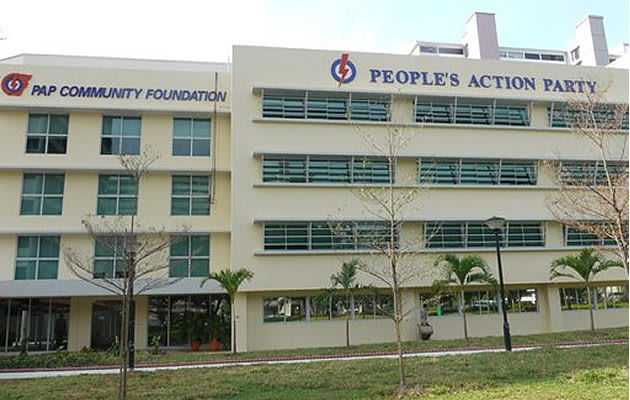 PAP still has many questions to answer, says our blogger.
(Yahoo! photo)
COMMENT
Just a day after
his party won Aljunied GRC in 2011’s general election, Low Thia
Khiang said he
hoped “he will get the People's Action Party's (PAP) cooperation”
in taking over the town council in the constituency.
“Mr Low also hopes
that there won't be 'any sabotage' like what he encountered in 1991
when he was first elected in the Hougang single-seat ward,” the
Straits Times reported.
Low, who is the
Workers’ Party’s secretary general, had had to vacate the Hougang
Town Council in Hougang Central and had to turn to his own business
contacts to build a new town council at Block 701, Hougang Avenue
2, within 45 days.
Four days after
losing Aljunied GRC, one of the PAP’s losing MPs there, Cynthia
Phua, gave assurance that there will be a smooth transition of the
town council. “We will do a proper handover,” she said.
“We will ensure that all the existing contracts that we have are
handed over to the new management properly.”
Dismissing
concerns that the PAP may sabotage the incoming WP team, Ms Phua
said: “The PAP is not that way. It has always been a fair and
responsible party. We are direct and transparent in our
actions.”
In politics, as
they say, sometimes things aren’t what they seem.
The ongoing saga
involving the PAP-owned company, Action Information Management Pte
Ltd (AIM), and its dealings with the WP’s Aljunied Hougang Town
Council, has raised numerous questions of propriety, transparency
and accountability. Several writers have written about and raised
very pertinent questions about the matter. [Read
them here and here.]
In a nutshell, the
PAP’s decision to sell the computer system developed by the 14 town
councils under its wings to a PAP-owned company is seen as a
deliberate attempt to scuttle the efforts of the WP in taking over
the running of the town council.
Explanations fall short
The coordinating
chairman of the 14 PAP town councils, Teo Ho Pin, has been trying
to explain the decision to sell the system to the PAP-owned AIM.
His latest 26-paragraph
statement, however, obfuscates more than it enlightens, and
more questions are raised as Teo seems to have avoided addressing
some of the main questions which members of the public have been
asking.
Questions such
as:
1.
Why leave residents at the mercy of a private entity?
2. How much was spent to develop the
software?
3. What were, specifically, the tender conditions
or requirements laid out in the original tender
advertisement?
4. How much, exactly, did AIM pay to purchase the
software? There has been no unequivocal statement on how much AIM
paid. News reports and Teo’s statement are vague, saying only that
AIM “offered to purchase the software for $140,000”.
An offer to
purchase is not the same as the actual amount paid for the
purchase.
While all these questions are important and Teo and the PAP should
address them immediately, they are not what perhaps are what the
most important issues here.
The big fat white
elephant in the room – which the PAP and Teo seem to have missed –
is the issue of a conflict of interest in selling the intellectual
property (IP) of software developed by the 14 PAP town councils and
paid for, presumably, by residents or taxpayers, to a PAP-owned
company run by three former PAP MPs.
As Alex Au wrote
in his blog article: “The most troubling thing is that Teo sees no
conflict of interest when putting state assets into partisan hands.
It does not matter how it is done, whether through a tender or
negotiated sale. The result is plain unacceptable.”
In the process,
the PAP town councils have given what is a private entity – and
owned by the PAP, no less – much power over the running by elected
MPs of town councils through a termination clause in the contract.
This was exactly what happened to the WP town council in Aljunied,
in fact, after it took over the town council there.
The PAP town
councils should not even have considered AIM’s bid, given the
obvious conflict of interests here.
Track
record
Some have
suggested, and not without some reasonableness, that the decision
to even put the system – one which Teo himself says was of
depreciating value – up for sale is a political one. Given the
experiences of opposition MPs in the past, it is not unreasonable
to entertain such a possibility.
Low’s experience
with the Hougang town council in 1991 is one example. The threat by
the PAP to pull out its kindergartens in opposition wards is
another. The discrimination of opposition wards in the HDB
upgrading programme is yet another example.
Then there is,
after the 2011 elections, the transference, by the HDB, of 6 plots
of land in Hougang and 26 sites in Aljunied GRC from the purview of
the town councils – which had fallen into WP’s hands – to the
People’s Association which is the umbrella organisation for all the
grassroots organisations (GROs) where PAP MPs or losing PAP
candidates are the “advisers”, and they invariably make use of
these public spaces and sites for their community activities.
In short,
opposition MPs no longer can use these sites, unless they have the
permission of the PA or the “grassroots advisers”. This is, in
effect, transferring the authority and power from MPs to
“grassroots advisers”.
There have also
been other instances of such unfair practices by the PAP and its
affiliated organisations.
This latest
episode with AIM is seen by many as another of these unfair or less
than gentlemanly practices, even as PAP MPs promised civility. It
is made even worse because it goes beyond the pale of what is
ethical. To be sure, no one is expecting political parties or
politicians to be angels. In this instance, however, it is the use
of taxpayers’ funds for the seemingly political self-interests of
the PAP which is grating.
More
expected
However Teo or the
PAP try to explain away the entire episode, or justify what they
have done, they would have missed the real reason for the public’s
unhappiness if they do not also understand that Singaporeans expect
more from their leaders.
What the public
wants and deserves are politicians who have the ability to
recognize that while some things may technically be legal, at times
it is the better and the more ethical thing to do to not
participate in such endeavours at all. In short, leaders must have
the gumption to rise above the pettiness of partisan politics and
not ingratiate themselves with dubious undertakings for selfish
interests.
In this instance,
what is disconcerting is that the PAP may have been aware of this
conflict of interest (as indeed it must have) but decided to go
ahead with the deal anyway. Why it did so would be anyone’s
guess.
But to give it the
benefit of the doubt, and as AIM is a “fully owned” entity of the
PAP, the PAP can address the fundamental issue of how its actions
have left residents at the mercy of this private entity and take
the necessary steps to address this.
After all, isn’t
the interest of the residents one which Teo is concerned about? Or
is he more bent on insulting them through explanations and
statements which are utterly unconvincing and which raise even more
doubts?
“I believe that 20
years on, Singapore has become a more civilised country,” Low said
on 8 May after winning Aljunied GRC, expressing his hope that the
PAP will not sabotage the handing over of the town council in the
ward.
The PAP’s
behavior, unfortunately, tells a different tale.


